
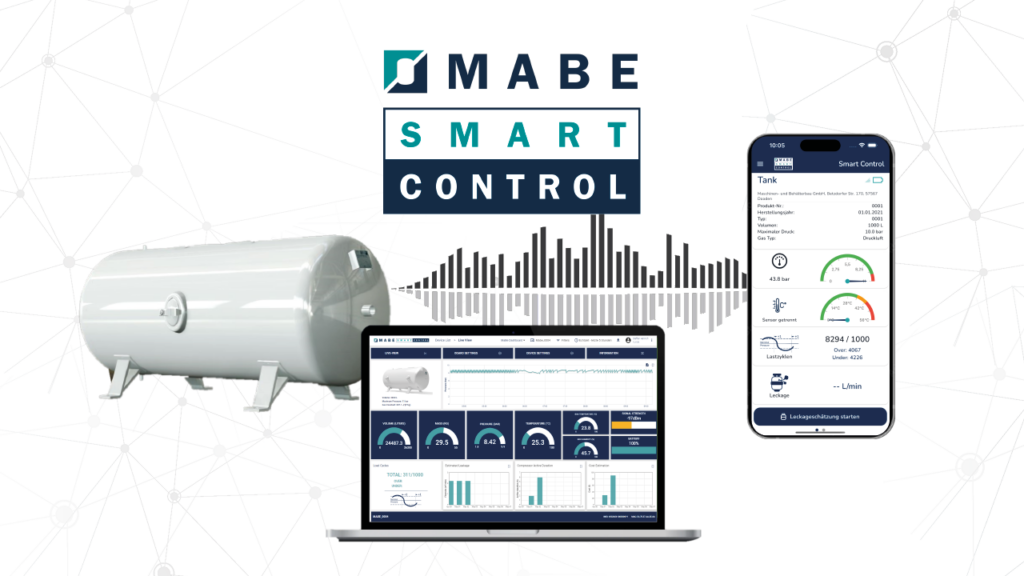
Successful collaboration between MASCHINEN- UND BEHÄLTERBAU GmbH and core sensing GmbH: Thanks to a cloud-enabled sensor system, the safety of compressed air tanks is increased, leaks and inefficiencies are made visible, thereby making a significant contribution to greater resource efficiency in production.
Cloud-Enabled Compressed Air Monitoring System Optimizes Safety and Resource Efficiency
Compressed air systems are an integral part of almost every manufacturing operation. Especially in times of rising energy prices and resource efficiency, energy-intensive consumers are being examined more closely. This is because energy-intensive compressors, compressed air storage tanks, and piping systems are necessary to provide compressed air. And this is precisely where inefficiency, increased maintenance requirements, and leaks can occur.
In collaboration with MASCHINEN- UND BEHÄLTERBAU GMBH, one of the leading manufacturers of pressure vessels, core sensing has developed a cloud-enabled compressed air monitoring system designed to meet the needs of safety- and energy-conscious plant operators. The sensor system is based on our latest measurement amplifier generation coreMOBILE and the sensor platform coreCLOUD and addresses two aspects in particular that are relevant for every operator of compressed air systems. The sensor system addresses two aspects in particular that are relevant for every operator of compressed air systems:
Increasing System Efficiency and Resource Conservation
Anyone who has ever walked through a production facility on a Friday afternoon knows that it is not a place of silence and contemplation. Many consumers still require compressed air even when switched off, while elsewhere the whistling sounds from leaks in the piping escape. To a certain extent, however, this is normal, and in fact, leaks can never be completely avoided within an economically viable framework. For most operators, their compressed air system is often a black box, where only what is put in is known and ultimately dissipates into air. However, what proportion is lost in the form of leaks, or which consumers operate with what efficiency, is generally not known. By conducting consumption analyses and detecting consumers as well as larger leaks with SMART CONTROL, informed decisions can be made about remedial measures.
Predictive Maintenance for the Pressure Tank and Increased Process Safety for Sensitive Consumers
With each partial emptying and filling of the compressed air vessel, it is subjected to significant mechanical stress, particularly at its welds. For safe operation of the compressed air vessel, a certain minimum pressure should therefore always be maintained—even at night and on weekends when the system is not needed—in order to keep the number of load cycles low.
It is therefore all the more important to keep both safety and resource efficiency in view. The SMART CONTROL monitoring system automatically records these load cycles, and thus (with appropriate handling of the vessel) the service life of the pressure vessel can be significantly extended and the maximum permitted inspection intervals can be fully utilized. Excessive load cycles cause the material to fatigue more quickly and inspection intervals are shortened. This increases costs due to more frequent inspections by the ZÜS (Authorized Inspection Body). For sensitive machines, it can be monitored and documented whether and how the necessary minimum pressure is ensured—for example, during peak loads or in shutdown mode. The mechanical load history and the number of load cycles are logged and can be used as a basis for decision-making for the next scheduled maintenance. In the long term, it is conceivable to adapt maintenance requirements to actual usage, which can be made visible for the first time through such a sensor system.
The plug-and-play measurement system consists of a pressure sensor + IoT sensor node and can be easily mounted on existing or new pressure vessels via a quick coupling. The IoT sensor node is powered by a standard USB-C power supply and can function as an autonomous sensor node from that point on.
Rapid Development Thanks to Modular IoT Sensor Platform from core sensing
For rapid implementation of the “Smart Control” monitoring and optimization system, MaBe decided to partner with core sensing. For MaBe, this has the advantage that it builds on an existing system, significantly reducing development time.
The main development activities consist of the following components:
- Adaptation of the existing LTE-enabled hardware to the requirements in the field of compressed air supply (pressure sensors, connections)
- Integration into housing
- Cloud dashboard and app with individual functions, for example for conducting reference measurements for leak determination.
- Conducting pilot measurements and deriving algorithms and rules that have been incorporated into the software.
In addition, core sensing actively supports the derivation of market requirements, technical and commercial market launch, and product promotion. Only with direct market feedback can the product be further developed and made intuitively usable. Ultimately, this close cooperation only pays off for both partners when the market accepts the product.

