
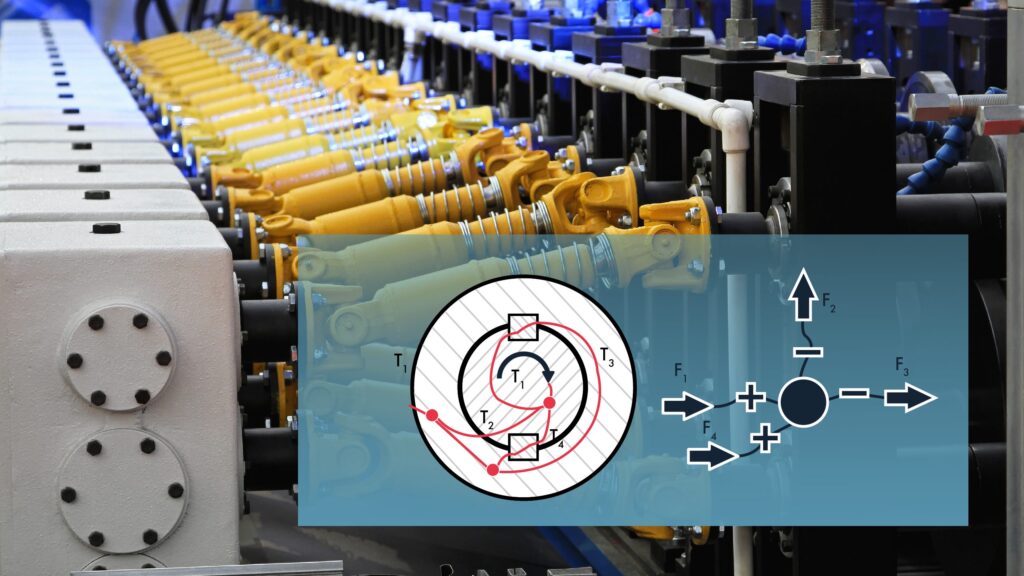
The integration of sensors into machine elements is becoming increasingly important, as sensor-integrated machine elements not only provide improved monitoring and control of processes, but also enable faster and more precise commissioning of systems. Sensor-integrated machine elements offer the possibility of extending existing systems with sensory functions through retrofitting or making minor modifications.
The Challenges of Commissioning Roll Forming Processes
The commissioning of roll forming processes is often time-consuming and has traditionally been based on empirical knowledge. This frequently leads to scrap until the correct machine settings are found. This is where the integration of measurement technology into machine elements comes into play. By measuring the load on individual rolls, processes can be made more reproducible and efficient. core sensing has worked together with its partners to solve this problem. Sensor-integrated machine elements have been developed.
The Load Path and Node Model: A Possible Approach for Developing Sensor-Integrated Machine Elements
The load path and node model was selected as a methodological approach to analyze the roll forming system, select suitable machine elements, and further develop them into sensor-integrated machine elements. The load path and node model provides a crucial approach for the development of sensor-integrated machine elements. It enables the evaluation of various substitute variables and supports the developer in decision-making by taking into account the complexity and uncertainty in creating calculation models between substitute variables and desired measured variables.
Load Path and Node Model Optimizes Roll Forming Systems with Cardan Shafts for Efficient Analysis and Minimization of Modifications
By applying the load path and node model, it was initially demonstrated that cardan shafts between the gearbox and stand prove to be a good solution, offering sufficient accuracy and requiring only minimal or no modifications to the design of the roll forming system. Subsequently, it was demonstrated how the load path and node model can be used to analyze the cardan shaft to identify a clear load path and recurring elements within the cardan shaft. This enables minimization of changes to the existing design and manufacturing steps.
Realized Customer Project – Sensory Cardan Shaft
In collaboration with cardan shaft expert Elso Elbe and digitalization expert core sensing, an innovative sensory cardan shaft has been developed based on coreIN, which can make an important contribution to the digitalization of machines and systems, thereby enabling assistance systems, condition monitoring, and predictive maintenance solutions. The sensory cardan shaft not only enables the measurement of torque and speed, but can also be retrofitted as a replacement component or installed as an OEM special version. By using the sensory cardan shaft, commissioning times can be shortened and dependence on the operator’s empirical knowledge can be reduced.
The Future of Mechanical Engineering
The integration of sensors into machine elements offers a multitude of advantages for mechanical engineering. It enables more precise monitoring and control of processes, shortens commissioning times, and reduces dependence on operator experience. Therefore, the project engineers at core sensing are actively working in close coordination with their partners, the manufacturers of machine elements as well as machines and systems, on the development of sensor-integrated machine elements and contributing their scientific expertise.
Overall, sensor-integrated machine elements play a key role in the advancement of mechanical engineering. Their use enables improvement of the performance and efficiency of machines and systems as well as employees through a created assistance system and contributes significantly to the competitiveness and future viability of the industry.

